
Blog

  • Upfront Ventures Raises > $650 Million for Startups and Returns > $600 Million to LPs

    Upfront Ventures Raises > $650 Million for Startups and Returns > $600 Million to LPs

    Photo by Scott Clark for Upfront Ventures (no, Evan is not standing on a box)

    Last year marked the 25th anniversary for Upfront Ventures and what a year it was. 2021 saw phenomenal returns for our industry and it topped off more than a decade of unprecedented VC growth.

    The industry has obviously changed enormously in 2022 but in many ways it feels like a “return to normal” that we have seen many times in our industry. Yves Sisteron, Stuart Lander & I (depicted in the photo below) have worked together for more than 22 years now and that has taken us through many cycles of market enthusiasm & panic. We’ve also worked with our Partner, Dana Kibler who is also our CFO for nearly 20 years.

    We believe this consistency in leadership and intuition for where the markets were going in the heady days of 2019–2021 helped us to stay sane in a world that momentarily seemed to have lost its mind and since we have new capital to deploy in the years ahead perhaps I can offer some insights into where we think value will be derived.
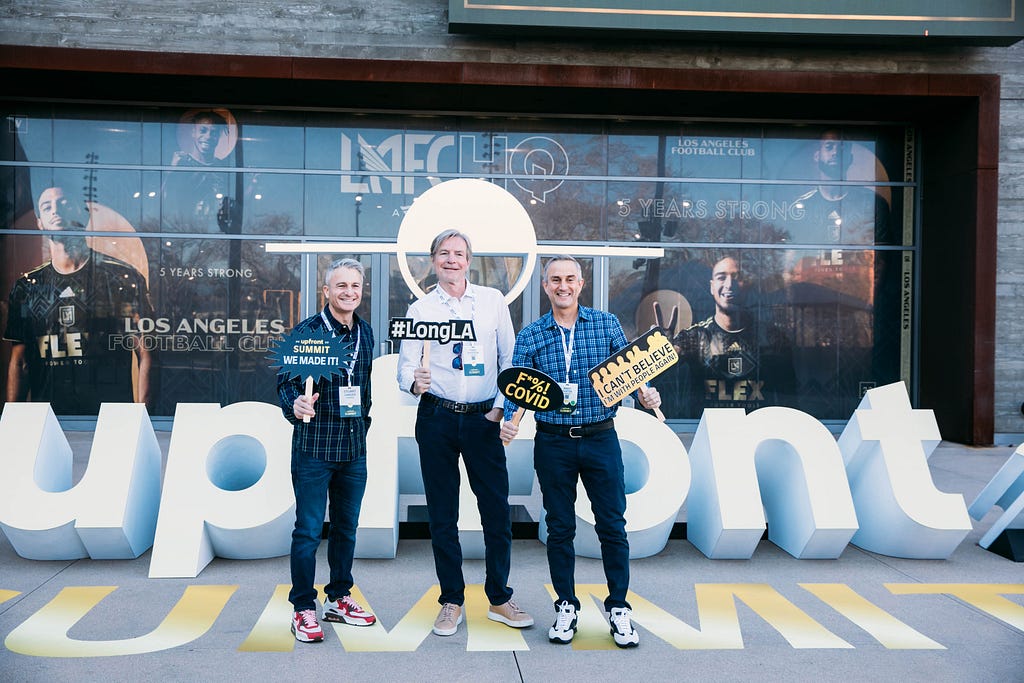
    Photo by Scott Clark for Upfront Ventures

    Focus on Cash

    While the headlines in 2020 & 2021 touted many massive fundraising events and heady valuations, we believed that for savvy investors it also represented an opportunity for real financial gains.

    Since 2021, Upfront returned more than $600 million to LPs and returned more than $1 billion since 2018.

    Considering that many of our funds are in the $200–300 million range, these returns were more meaningful than if we had raised billion dollar funds. We remain confident in the long-term trend that software enables and the value accrued to disruptive startups; we also recognized that in a strong market it is important to ring the cash register and this doesn’t come without a concentrated effort to do so.

    Obviously the funding environment has changed considerably in 2022 but as early-stage investors our daily jobs stay largely unchanged. And while over the past few years we have been laser-focused on cash returns, we are equally planting seeds for our next 10–15 years of returns by actively investing in today’s market.

    We are excited to share the news that we have raised $650 million across three vehicles to allow us to continue making investments for many years ahead.

    We are proud to announce the close of our 7th early-stage fund with $280 million to invest in seed and early stage founders.

    Alongside Upfront VII we are also now deploying our third growth-stage fund, which has $200 million in commitments and our Continuation Fund of more than $175 million.

    What do you do with a $650 million platform?

    Photo by Scott Clark for Upfront Ventures

    A question I often hear is “how is Upfront changing given the current market?” The answer is: not much. In the past decade we have remained consistent, investing in 12–15 companies per year at the earliest stages of their formation with a median first check size of approximately $3 million.

    If I look back to the beginning of the current tech boom which started around 2009, we often wrote a $3–5 million check and this was called an “A round” and 12 years later in an over-capitalized market this became known as a “Seed Round” but in truth what we do hasn’t changed much at all.
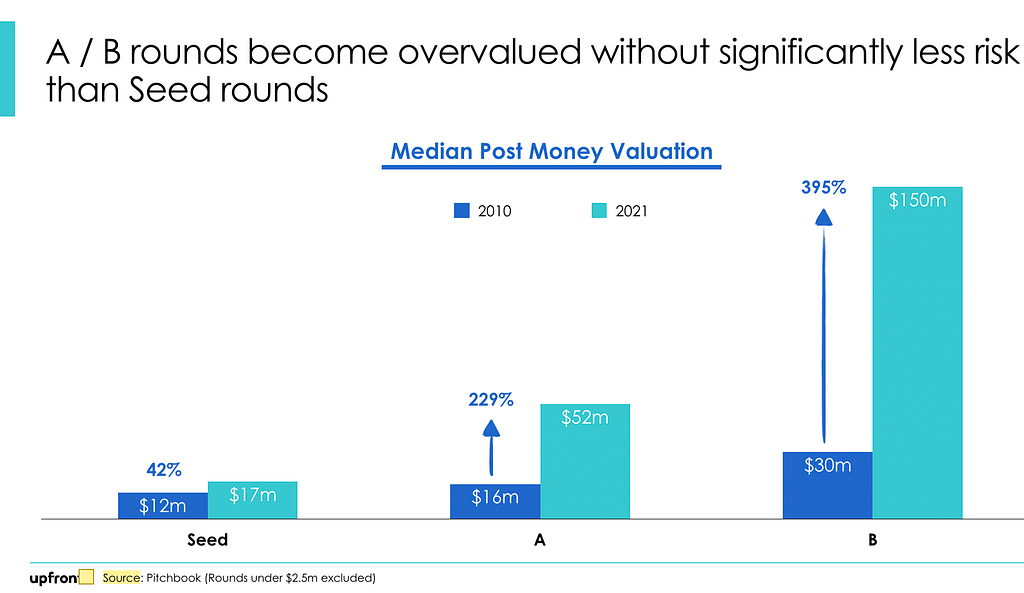
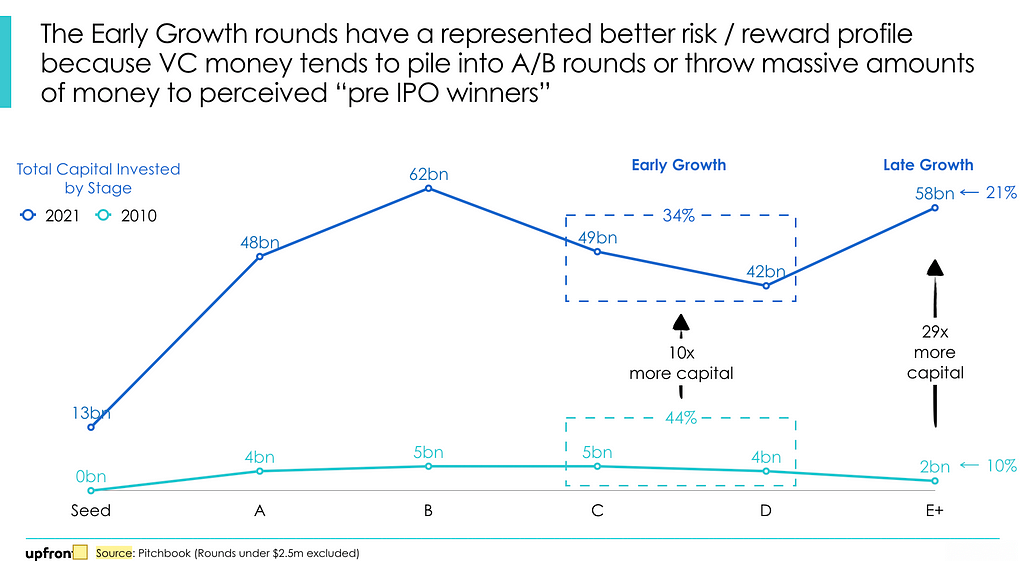
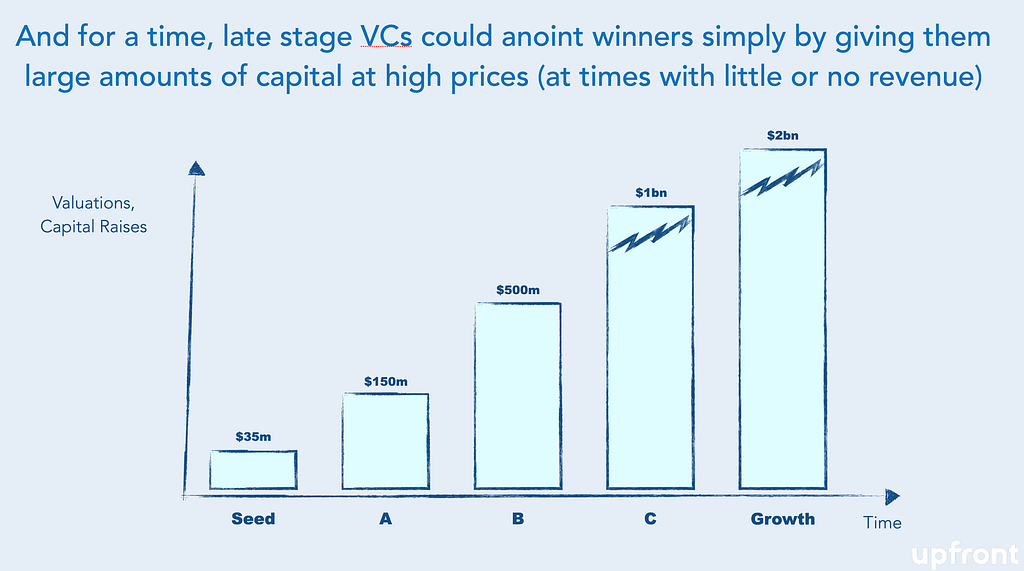
    And if you look at the above data you can see why Upfront decided to stay focused on the Seed Market rather than raise larger funds and try and compete for A/B round deals. As money poured into our industry, it encouraged many VCs to write $20–30 million checks at increasingly higher and higher valuations where it is unlikely that they had substantively more proof of company traction or success.

    Some investors may have succeeded with this strategy but at Upfront we decided to stay in our lane. In fact, we published our strategy some time ago and announced we were moving to a “barbell strategy” of funding at the Seed level, mostly avoiding the A/B rounds and then increasing our investments in the earliest phases of technology growth.
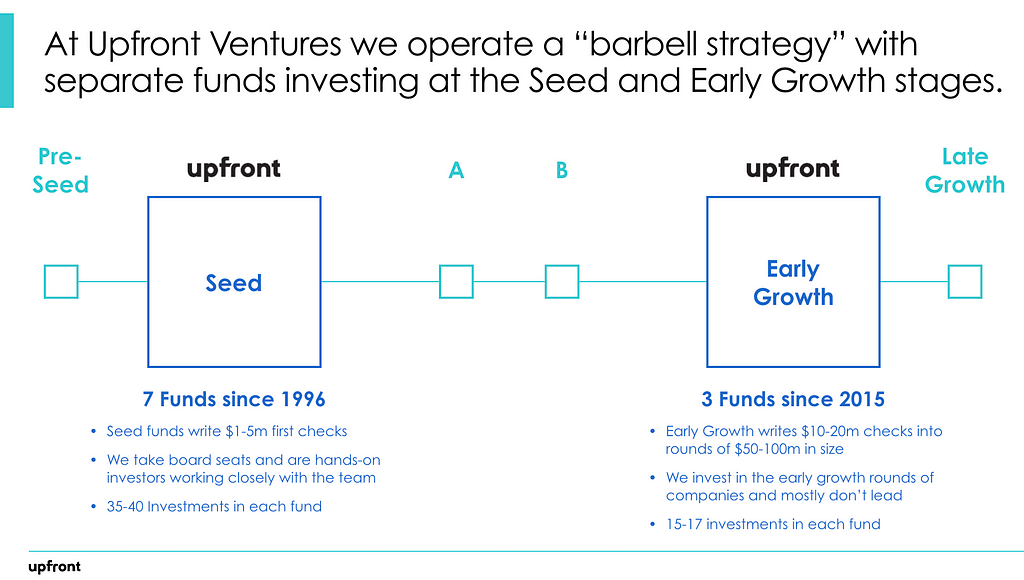
    When we get involved in Seed investments we usually represent 60–80% in one of the first institutional rounds of capital, we almost always take board seats and then we serve these founders over the course of a decade or longer. In our best-performing companies we often write follow-on checks totaling up to $10–15 million out of our early-stage fund.

    Beginning in 2015 we realized that the best companies were staying private for longer so we started raising Growth Vehicles that could invest in our portfolio companies as they got bigger but could also invest in other companies that we had missed at the earliest stages and this meant deploying $40–60 million in some of our highest-conviction companies.
    Size Matters

    But why have we decided to run separate funds for Seed and for Early Growth and why didn’t we just lump it all into one fund and invest out of just one vehicle? That was a question I had been asked by LPs in 2015 when we began our Early Growth program.

    In short,

    In Venture Capital, Size Matters

    Size matters for a few reasons.

    As a starting point we believe it is easier to consistently return multiples of capital when you aren’t deploying billions of dollars in a single fund as Fred Wilson has articulated consistently in his posts on “small ball” and small partnerships. Like USV we are usually investing in our Seed fund when teams are fewer than 10 employees, have ideas that are “out there” and where we plan to be actively engaged for a decade or longer. In fact, I am still active on two boards where I first invested in 2009.

    The other argument I made to LPs at the time was that if we combined $650 million or more into a single fund it would mean that writing a $3–4 million would feel too small to each individual investor to be important and yet that’s the amount of capital we believed many seed-stage companies needed. I saw this at some of my peers’ firms where increasingly they were writing $10+ million checks out of very large funds and not even taking board seats. I think somehow the larger funds desensitized some investors around check sizes and incentivized them to search for places to deploy $50 million or more.

    By contrast, our most recent Early Growth fund is $200 million and we seek to write $10–15 million into rounds that have $25–75 million in capital including other investment firms and each and every commitment really matters to that fund.

    For Upfront, constrained size and extreme team focus has mattered.

    But What Has Changed at Upfront?

    What has shifted for Upfront in the past decade has been our sector focus. Over the past ten years we have focused on what we believe will be the most important trends of the next several decades rather than concentrating on what has driven returns in the past 10 years. We believe that to drive returns in venture capital, you have to get three things correct:

    1. You need to be right about the technology trends are going to drive society
    2. You need to be right about the timing, which is 3–5 years before a trend (being too early is the same as being wrong & if you’re too late you often overpay and don’t drive returns)
    3. You need to back the winning team

    Getting all three correct is why it is very difficult to be excellent at venture capital.

    What that means to us at Upfront today and moving forward with Upfront VII and Growth III is a deeper concentration on those categories where we anticipate the most growth, the most value creation, and the biggest impact, most specifically:

    • Healthcare & Applied Biology
    • Defense Technologies
    • Computer Vision
    • Ag Tech & Sustainability
    • Fintech
    • Consumerization of Enterprise Software
    • Gaming Infrastructure

    None of these categories are new for us, but with this fund we are doubling down on our areas of enthusiasm and expertise.

    How do we plan to do it?

    Venture capital is a talent game, which starts with the team that’s inside Upfront. The Upfront VII and Growth teams are made up of 10 partners: 6 leading investment activities & 4 supporting portfolio companies including Talent, Marketing, Finance & Operations.

    Most who know Upfront are aware that we are based out of Los Angeles where we deploy ~40% of our capital but as I like to point out, that means the majority of our capital is deployed outside of LA! And the number one destination outside of LA is San Francisco.

    So while some investors have announced they’re moving to Austin or Miami we have actually been increasing our investments in San Francisco, opening an office with 7 investment professionals that we’ve been slowly building over the past few years. It is led by two partners: Aditi Maliwal on the Seed Investment Team who also leads our Fintech practice and Seksom Suriyapa on the Growth Team who joined Upfront in 2021 after most recently leading Corp Dev at Twitter (and before that at Success Factors and Akamai).

    The more things change, the more they stay the same.

    So while our investing platform has grown in both size and focus, and while the market is transitioning into a new and potentially more challenging reality (at least for a few years) — in the most important ways, Upfront remains committed to what we’ve always focused on.

    We believe in being active partners with our portfolio, working alongside founders and executive teams in both good times and in more challenging times. When we invest, we commit to being long-term partners to our portfolio and we take that responsibility seriously.

    We have strong views, take strong positions, and operate from a place of strong conviction when we invest. Every founder in our portfolio is there because an Upfront partner had unwavering belief in their potential and did whatever it took to get the deal done.

    We are so thankful to the LPs who continue to trust us with their capital, time and conviction. We feel blessed to work alongside startup founders who are really rising to the challenge of the more difficult funding environment. Thank you to everybody in the community who has supported us all these years. We will continue to work hard to make you all proud.

    Thank you, thank you, thank you.


    Upfront Ventures Raises > $650 Million for Startups and Returns > $600 Million to LPs was originally published in Both Sides of the Table on Medium, where people are continuing the conversation by highlighting and responding to this story.
  • What Does the Post Crash VC Market Look Like?

    What Does the Post Crash VC Market Look Like?

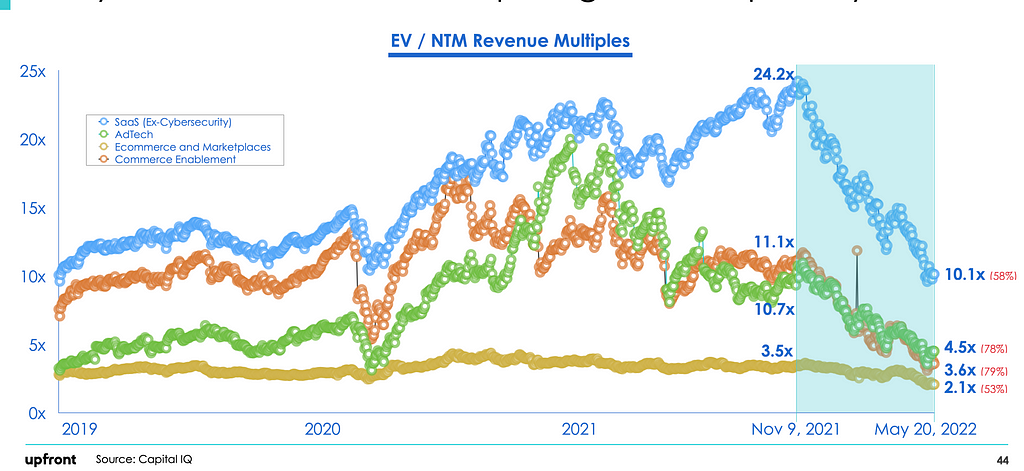
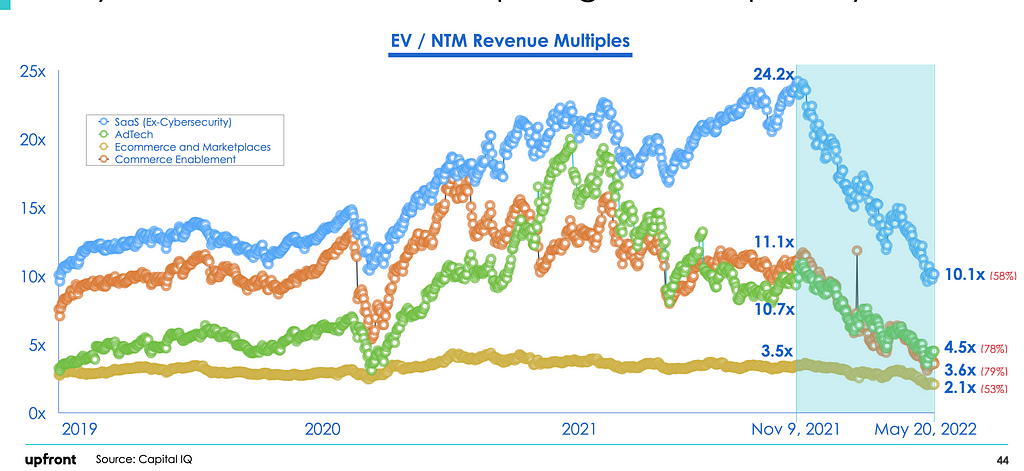
    At our mid-year offsite our partnership at Upfront Ventures was discussing what the future of venture capital and the startup ecosystem looked like. From 2019 to May 2022, the market was down considerably with public valuations down 53–79% across the four sectors we were reviewing (it is since down even further).

    ==> Aside, we also have a NEW LA-based partner I’m thrilled to announce: Nick Kim. Please follow him & welcome him to Upfront!! <==

    Our conclusion was that this isn’t a temporary blip that will swiftly trend-back up in a V-shaped recovery of valuations but rather represented a new normal on how the market will price these companies somewhat permanently. We drew this conclusion after a meeting we had with Morgan Stanley where they showed us historical 15 & 20 year valuation trends and we all discussed what we thought this meant.

    Should SaaS companies trade at a 24x Enterprise Value (EV) to Next Twelve Month (NTM) Revenue multiple as they did in November 2021? Probably not and we think 10x (May 2022) seems more in line with the historical trend (actually 10x is still high).

    What You Can Learn From Public Markets

    It doesn’t really take a genius to realize that what happens in the public markets is highly likely to filter back to the private markets because the ultimate exit of these companies is either an IPO or an acquisition (often by a public company whose valuation is fixed daily by the market).

    This happens slowly because while public markets trade daily and prices then adjust instantly, private markets don’t get reset until follow-on financing rounds happen which can take 6–24 months. Even then private market investors can paper over valuation changes by investing at the same price but with more structure so it’s hard to understand the “headline valuation.”

    But we’re confident that valuations will get reset. First in late-stage tech companies and then it will filter back to Growth and then A and ultimately Seed Rounds.

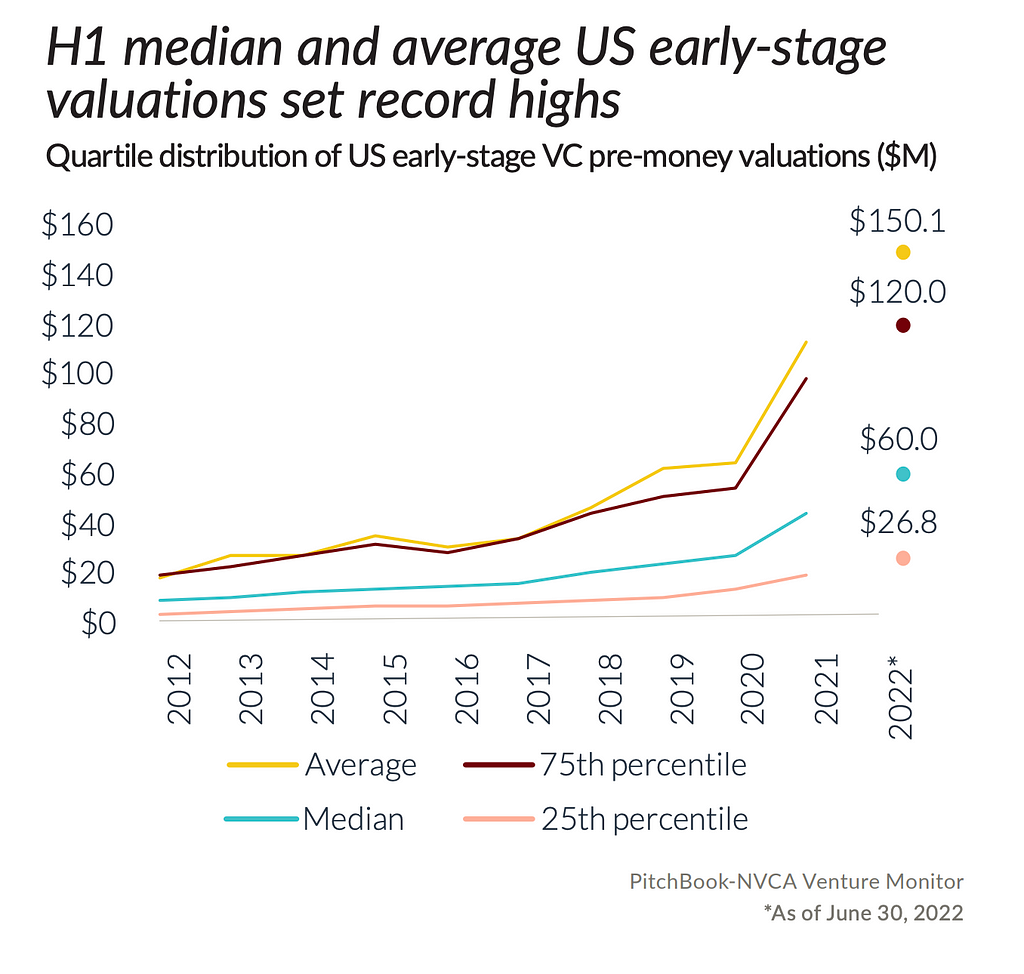
    And reset they must. When you look at how much median valuations were driven up in the past 5 years alone it’s bananas. Median valuations for early-stage companies tripled from around $20m pre-money valuations to $60m with plenty of deals being prices above $100m. If you’re exiting into 24x EV/NTM valuation multiples you might overpay for an early-stage round, perhaps on the “greater fool theory” but if you believe that exit multiples have reached a new normal, it’s clear to me: YOU. SIMPLY. CAN’T. OVERPAY.

    It’s just math.

    No blog post about how Tiger is crushing everybody because it’s deploying all its capital in 1-year while “suckers” are investing over 3-years can change this reality. It’s easy to make IRRs work really well in a 12-year bull market but VCs have to make money in good markets and bad.

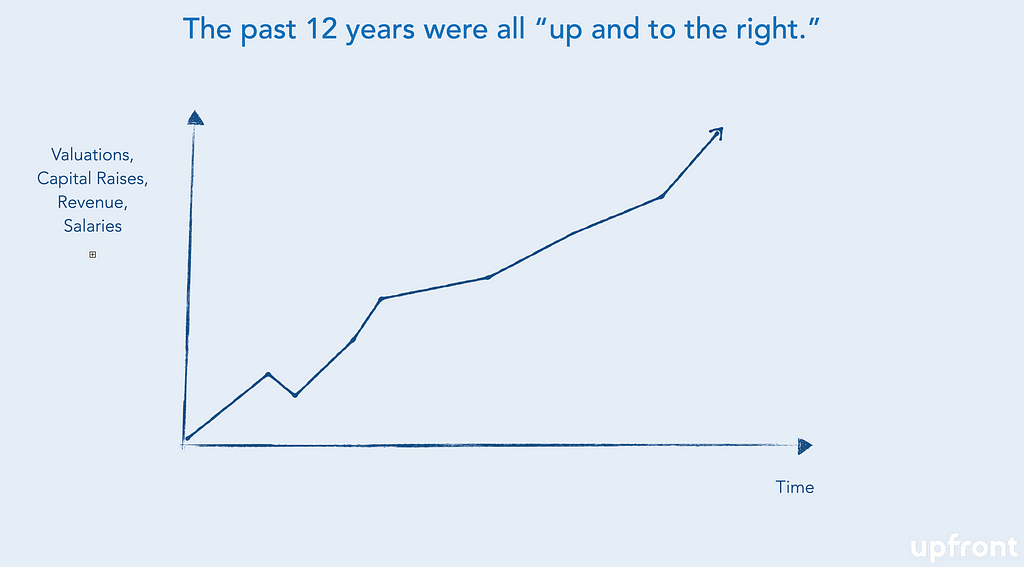
    In the past 5 years some of the best investors in the country could simply anoint winners by giving them large amounts of capital at high prices and then the media hype machine would create awareness, talent would race to join the next perceived $10bn winner and if the music never stops then everybody is happy.

    Except the music stopped.

    What Happens Next?

    There is a LOT of money still sitting on the sidelines waiting to be deployed. And it WILL be deployed, that’s what investors do.

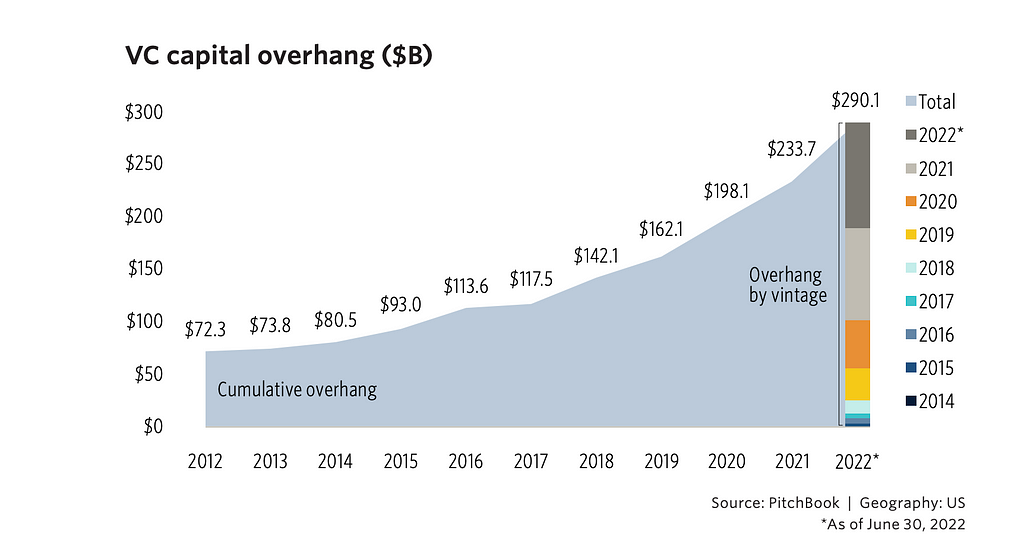
    Pitchbook estimates that there is about $290 billion of VC “overhang” (money waiting to be deployed into tech startups) in the US alone and that’s up more than 4x in just the past decade. But I believe it will be patiently deployed, waiting for a cohort of founders who aren’t artificially clinging to 2021 valuation metrics.

    I talked to a couple of friends of mine who are late-stage growth investors and they basically told me, “we’re just not taking any meetings with companies who raised their last growth round in 2021 because we know there is still a mismatch of expectations. We’ll just wait until companies that last raised in 2019 or 2020 come to market.”

    I do already see a return of normalcy on the amount of time investors have to conduct due diligence and make sure there is not only a compelling business case but also good chemistry between the founders and investors.

    What is a VC To Do?

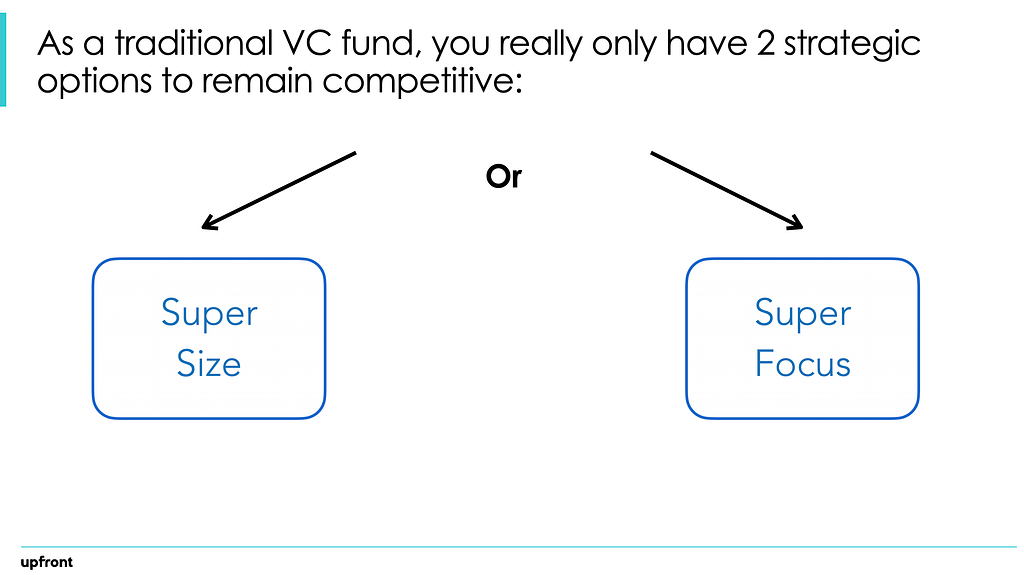
    I can’t speak for every VC, obviously. But the way we see it is that in venture right now you have 2 choices — super size or super focus.

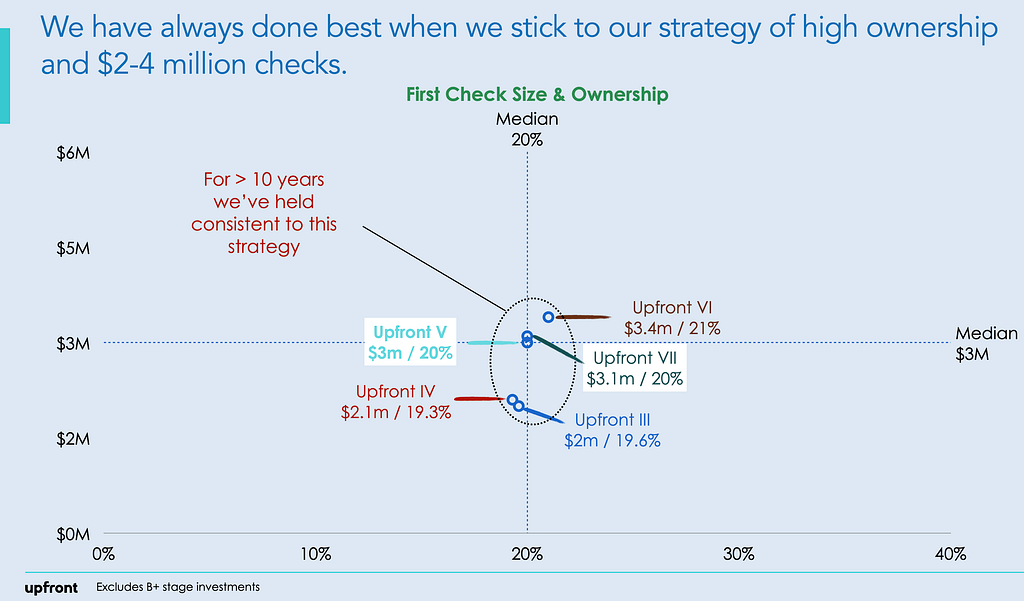
    At Upfront we believe clearly in “super focus.” We don’t want to compete for the largest AUM (assets under management) with the biggest firms in a race to build the “Goldman Sachs of VC” but it’s clear that this strategy has had success for some. Across more than 10 years we have kept the median first check size of our Seed investments between $2–3.5 million, our Seed Funds mostly between $200–300 million and have delivered median ownerships of ~20% from the first check we write into a startup.

    I have told this to people for years and some people can’t understand how we’ve been able to keep this strategy going through this bull market cycle and I tell people — discipline & focus. Of course our execution against the strategy has had to change but the strategy has remained constant.

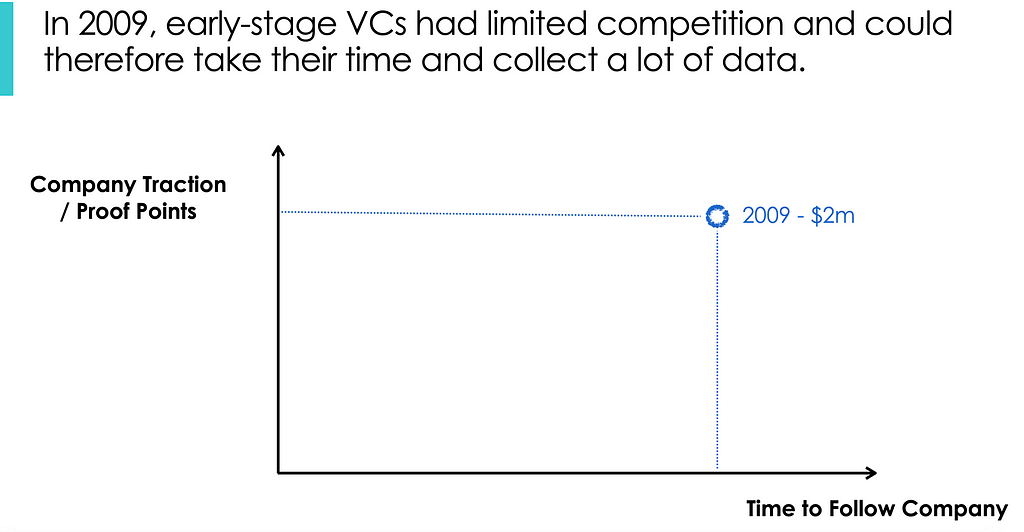
    In 2009 we could take a long time to review a deal. We could talk with customers, meet the entire management team, review financial plans, review customer purchasing cohorts, evaluate the competition, etc.

    By 2021 we had to write a $3.5m first check on average to get 20% ownership and we had much less time to do an evaluation. We often knew about the teams before they actually set up the company or left their employer. It forced extreme discipline to “stay in our swimming lanes” of knowledge and not just write checks into the latest trend. So we largely sat out fundings of NFTs or other areas where we didn’t feel like we were the expert or where the valuation metrics weren’t in line with our funding goals.

    We believe that investors in any market need “edge” … knowing something (thesis) or somebody (access) better than almost any other investor. So we stayed close to our investment themes of: healthcare, fintech, computer vision, marketing technologies, video game infrastructure, sustainability and applied biology and we have partners that lead each practice area.

    We also focus heavily on geographies. I think most people know we’re HQ’d in LA (Santa Monica to be exact) but we invest nationally and internationally. We have a team of 7 in San Francisco (a counter bet on our belief that the Bay Area is an amazing place.) Approximately 40% of our deals are done in Los Angeles but nearly all of our deals leverage the LA networks we have built for 25 years. We do deals in NYC, Paris, Seattle, Austin, San Francisco, London — but we give you the ++ of also having access in LA.

    To that end I’m really excited to share that Nick Kim has joined Upfront as a Partner based out of our LA offices. While Nick will have a national remit (he lived in NYC for ~10 years) he is initially going to focus on increasing our hometown coverage. Nick is an alum of UC Berkeley and Wharton, worked at Warby Parker and then most recently at the venerable LA-based Seed Fund, Crosscut.

    How Does the Industry Really Work?

    Anybody who has studied the VC industry knows that it works by “power law” returns in which a few key deals return the majority of a fund. For Upfront Ventures, across > 25 years of investing in any given fund 5–8 investments will return more than 80% of all distributions and it’s generally out of 30–40 investments. So it’s about 20%.

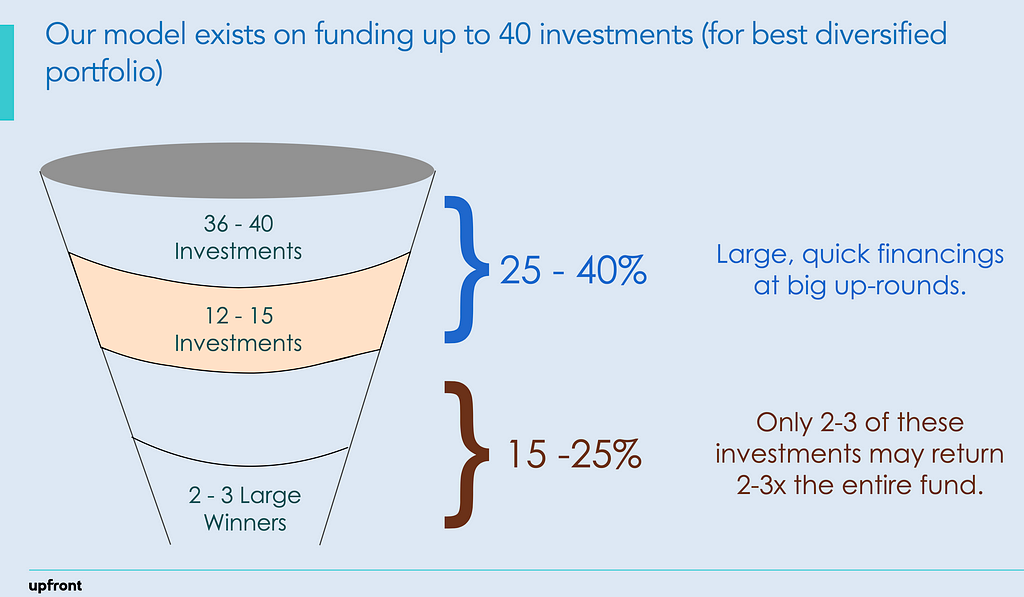
    But I thought a better way of thinking about how we manage our portfolios is to think about it as a funnel. If we do 36–40 deals in a Seed Fund, somewhere between 25–40% would likely see big up-rounds within the first 12–24 months. This translates to about 12–15 investments.

    Of these companies that become well financed we only need 15–25% of THOSE to pan out to return 2–3x the fund. But this is all driven on the assumption that we didn’t write a $20 million check out of the gate, that we didn’t pay a $100 million pre-money valuation and that we took a meaningful ownership stake by making a very early bet on founders and then partnering with them often for a decade or more.

    But here’s the magic few people ever talk about …

    We’ve created more than $1.5 billion in value to Upfront from just 6 deals that WERE NOT immediately up and to the right.

    The beauty of these businesses that weren’t immediate momentum is that they didn’t raise as much capital (so neither we nor the founders had to take the extra dilution), they took the time to develop true IP that is hard to replicate, they often only attracted 1 or 2 strong competitors and we may deliver more value from this cohort than even our up-and-to-the-right companies. And since we’re still an owner in 5 out of these 6 businesses we think the upside could be much greater if we’re patient.

    And we’re patient.


    What Does the Post Crash VC Market Look Like? was originally published in Both Sides of the Table on Medium, where people are continuing the conversation by highlighting and responding to this story.
  • Praying to the God of Valuation

    Praying to the God of Valuation

    Something happened in the past 7 years in the startup and venture capital world that I hadn’t experienced since the late 90’s — we all began praying to the God of Valuation. It wasn’t always like this and frankly it took a lot of joy out of the industry for me personally.

    What happened? How might our next phase of the journey seem brighter, even with more uncertain days for startups and capital markets?

    A LOOK BACK

    I started my career as a programmer. In those days we did it for the joy of problem-solving and seeing something we created in our brains be realized in the real world (or at least the real, digital world). I have often thought that creative endeavors where one has a quick turn-around between idea and realization of one’s work as one of the more fulfilling experiences in life.

    There was no money train. It was 1991. There were startups and a software industry but barely. We still loved every moment.

    The browser and thus the WWW and the first Internet businesses were born circa 1994–95 and there was a golden period where anything seemed possible. People were building. We wanted new things to exist and to solve new problems and to see our creations come to life.

    And then in the late 90’s money crept in, swept in to town by public markets, instant wealth and an absurd sky-rocketing of valuations based on no reasonable metrics. People proclaimed that there was a “new economy” and “the old rules didn’t apply” and if you questioned it you “just didn’t get it.”

    I started my first company in 1999 and was admittedly swept up in all of this: Magazine covers, fancy conferences, artificial valuations and easy money. Sure, we built SaaS products before the term even existed but at 31 it was hard to delineate reality from what all of the monied people around us were telling us what we were worth. Until we weren’t.

    2001–2007: THE BUILDING YEARS

    The dot com bubble had burst. Nobody cared about our valuations any more. We had nascent revenues, ridiculous cost structures and unrealistic valuations. So we all stopped focusing on this and just started building. I loved those salad days when nobody cared and everything was hard and nobody had any money.

    I remember once seeing Marc Andreessen sitting in a booth at The Creamery in Palo Alto and nobody seemed to take any notice. If they didn’t care about him they certainly didn’t care about me or Jason Lemkin or Jason Calacanis or any of us. I would see Marc Benioff in the line for Starbucks at One Market in San Francisco and probably few could pick him out of a line up then. Steve Jobs still walked from his house on Waverly to the Apple Store on University Ave.

    In those years I learned to properly build product, price products, sell products and serve customers. I learned to avoid unnecessary conferences, avoid non-essential costs and strive for at least a neutral EBITDA if for no other reason than nobody was interested in giving us any more money.

    Between 2006–2008 I sold both companies that I had started and became a VC. I didn’t make enough to buy a tiny island but I made enough to change my life and do some things that I loved out of a love for the game vs. the necessity of playing.

    SEEING THINGS FROM THE VC SIDE OF THE TABLE

    While I was a VC in 2007 & 2008 those were dead years because the market again evaporated due the the Global Financial Crisis (GFC). Almost no financings, many VCs and tech startups cratered for the second time in less than a decade following the dot com bursting. In retrospect it was a blessing for anybody becoming a VC back then because there were no expectations, no pressure, no FOMO and you could figure out where you wanted to make your mark in the world.

    Starting in 2009 I began writing checks consistently, year-in and year-out. I was in it for the love of working with entrepreneurs on business problems and marveling at technology they had built. I had realized that I didn’t have it within me to be as good of a player as many of them did but I had the skills to help as mentor, coach, friend, sparing partner and patient capital provider. Within 5 years I was on the board of real businesses with meaningful revenue, strong balance sheets, no debt and on the path to a few interesting exits.

    During this era, from 2009–2015, most founders I knew were in it for building great & sustainable companies. They wanted to build new products, solve problems that were unfilled by the last generation of software companies and grow revenue year-over-year while holding costs in check. Raising capital remained difficult but possible and valuations were tied to underlying performance metrics and everybody accepted the the ultimate exit — whether through M&A or IPO — would also be based on some level of rational pricing.

    WHEN OUR INDUSTRY CHANGED — THE ERA OF THE UNICORN

    Aileen Lee of Cowboy Ventures first coined the term Unicorn in 2013, ironically to signal that very few companies ever achieved a $1 billion valuation. By 2015 it had come to signify by the market a new era where business fundamentals had changed, companies could easily and quickly be worth $10 billion or MORE so why worry about the “entry price!”

    I wrote a post in 2015 that memorialized at the time how I felt about all of this, titled, “Why I Fucking Hate Unicorns and the Culture They Breed.” I admit that my writing style back then was a bit more carefree, provocative and opinionated. The last seven years has softened me and I yearn for more inner peace, less angst, less outrage. But if I were to rewrite that piece again I would only change the tone and not the message. In the past 7 years we built cultures of quick money, instant wealth and valuations for valuations sake.

    This era was dominated by a ZIRP (zero interest rate policy) of the federal reserve and easy money in search of high yields and encouraging growth at all costs. You had the entry into our ecosystem of hedge funds, cross-over funds, sovereign wealth funds, mutual funds, family offices and all other sources of capital that drove up valuations.

    And it changed the culture. We all began to pray to the altar of the almighty valuation. It was nobody’s fault. It’s just a market. I find it funny when people try to blame VCs or LPs or CEOs as though anybody could choose to control a market. Ask Xi or Putin how that’s going for them.

    Valuations were a measure of success. They were a way to gather cheap capital. It was a way to make it hard for your competition to compete. It was a way to attract the best talent, buy the best startups, capture headlines and keep growing your … valuation.

    In stead of growing revenue and holding down costs and building great company cultures the market chased valuation validation. In a market doing this it becomes very hard to do otherwise.

    And the valuation party lasted until November 9th, 2021. We had lamp shades on our heads, tequila in our glasses, loud music and perhaps too much sand, and burning men, and art exhibits and tres commas. The hang over was bound to be searing and last longer and drive some people to stop playing the game altogether.

    We’re still trying to find our sober equilibrium. We are not there yet but I seem signs of sobriety and a new generation of startups who never had access to the Kool Aid.

    THE VC VALUATION GOD

    Valuation obsession wasn’t restricted to startups. In a world when LPs benchmark VC performance on a 3-year time horizon from deploying one’s fund (is your 2019 fund in the top quartile!!??) you are bound to pray to the valuation Gods. Up and to the right or perish. I see your $500 million fund and I raise you with a $1.5 billion fund. Top that! Oh, $10 billion? Whoa. Hey, we got to raise again next year. Let’s deploy faster!

    We were told that Tiger was going to eat the VC industry because they deployed capital every year and didn’t take board seats. How’s that advice holding up?

    So now our collective companies are worth less. If we took them public we are naked now. The tide has gone out. If they are private we still have fig leaves that cover us because some rounds might raise debt vs. equity or might fund with terms like multiple liquidation preferences or full-ratchets or convertible notes with caps. But this is still all about valuations and none of it is any fun anymore.

    A REVERSION TO THE MEAN

    I don’t have a crystal ball for 2023–2027 but I have some guesses as to where the new sober markets may go and just like in our personal lives a little less alcohol may make us fundamentally happier, healthier, in it for the right reasons and able to wake up every morning and continue our journeys in peace and for the right reasons.

    I am enjoying more discussions with startups about the ROI benefits for customers who use our products rather than the coolness of our products. I am enjoying more focus on how to build sustainable businesses that don’t rely on ever more capital and logarithmically increasing valuations. I find comfort in founders in love with their markets and products and visions — whatever the economic consequences. I am confident money will be made be people who frugally and doggedly follow their passions and build things of real substance.

    There will always be outliers like Figma or Stripe or perhaps OpenAI or the like who create some fundamental and persistent and massive change in a market and who gather outsized returns and valuations and rightly so.

    But the majority of the industry has always been made by amazing entrepreneurs who build out of the extreme spotlight of the industry and build 12-year “overnight successes” where they wake up and have $100m+ in revenue, positive EBITDA and a chance to control their own destiny.

    I am having fun again. Truly it’s the first time I’ve felt this way in 5 years or so.

    I told my colleagues at our annual holiday party this past week that 2022 has been my most fulfilling as a VC and I’ve been doing this for > 15 years and nearly 10 more as an entrepreneur. I feel this way because no matter how much founders are kicked in the shins by the financial markets or by customer markets I always find some who dust themselves off, cut their coats according to their cloth, and carry on determined to succeed.

    Deep down I love working with founders and products, strategy, go-to-market, financial management, pricing and all aspects of building a startup. I suppose if I loved spreadsheets and valuations and benchmarking I would work in the even more lucrative world of late-stage private equity. It’s just not me.

    So we’re back to building real businesses. And that personally brings me way more joy than the obsession with valuations. I feel confident if we focus on the former the latter will take care of itself.

    Photo by Ismael Paramo on Unsplash


    Praying to the God of Valuation was originally published in Both Sides of the Table on Medium, where people are continuing the conversation by highlighting and responding to this story.
  • Why the Future of Space Starts in LA

    Why the Future of Space Starts in LA

    Credit: Apex

    Today, Apex announced their Series B funding round, led by XYZ Ventures and CRV, with participation from Upfront. And if you spend much time in LA, you’ll quickly realize that we’re in a groundswell of space and defense startups.

    Is it because of the rich engineering talent coming out of Caltech, UCLA, USC, Harvey Mudd, and all the other universities?

    Is it because of the long history in the region of aerospace and aviation expertise, from Northrup Grumman and Lockheed Martin to JPL and Nasa?

    Is it because SpaceX spearheaded a pool of startup-minded thinkers who are now starting their own businesses?

    It’s all of those things. And all of those things contributed to Ian Cinnamon founding Apex right here in California. Apex builds satellite buses quicker and more affordably than ever before, allowing companies to rapidly expand critical satellite deployment.

    Recently I had the pleasure of speaking with Ian on This Week in Startups. So rather than writing a long blog post about why this business is so necessary (it is) and why we at Upfront are so excited to support it (we are), I’ll let you hear straight from him about:

    • The origin of Apex and why it had to be built in Los Angeles
    • Why space is a desirable sector for investors and founders
    • The complexities of building satellites (and how Apex has unlocked the market)
    • The launch of its first satellite and taking a selfie from space

    I hope you’ll check out the conversation here, and join me in congratulating Ian, Max, and Apex team on today’s milestone.


    Why the Future of Space Starts in LA was originally published in Both Sides of the Table on Medium, where people are continuing the conversation by highlighting and responding to this story.
  • Ex-Network International execs raise $6M for Enza, an African fintech serving banks

    Over the past decade, Dubai-based Network International has become one of the dominant payment processors across the Middle East and Africa, thanks in part to a pair of acquisitions. However, many large incumbents can fall prey to slower innovation, opening the door for smaller, faster-moving startups. The latest development is Enza, a fintech founded in […]